
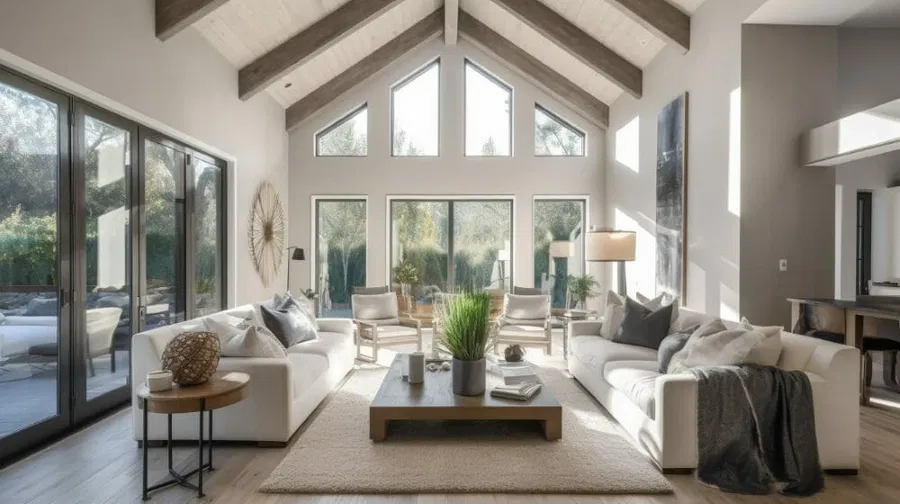
Since flooring takes up a lot of visible space in any space, its impact on interior design extends far beyond the floor. A well-chosen wood floor may enhance a room’s sense of proportion, give furniture a more deliberate appearance, and provide a unified visual link between various areas.
Therefore, selecting a favorite color shouldn’t be the first step in choosing wood flooring. The finished interior may be affected by grain movement, plank size, finish, undertones, and even the orientation of the boards. A far more coherent outcome may be achieved by taking these components into account in addition to the current design.
Start With The Interior’s Mood
First, consider the mood you want the space to evoke. Wood with noticeable knots and natural grain variations may be ideal for a laid-back environment. Smoother boards and more uniform coloring might complement more polished areas.
Simplicity is often crucial for minimalist home design. Clean furniture lines and well-chosen decorative elements may stand out on flooring with delicate grain patterns. Conversely, deeper tones and more pronounced wood qualities might be used in traditional spaces.
Think about how the floor affects the whole atmosphere rather than considering it as a stand-alone element.
Be Aware Of Undertones
Because of their undertones, two wood floors that first seem comparable might act quite differently after installation. While certain woods have cooler grey or neutral qualities, others lean warm with honey, crimson, or golden undertones.
Prior to making a choice, consider permanent characteristics. Because they are unlikely to change often, kitchen cabinets, stone worktops, built-in furniture, wall treatments, and massive architectural features are especially significant.
When building residences where many functional sections could be visible at once, this can be extremely helpful for homeowners looking at wood flooring NYC. The kitchen, dining room, and living area may all be visually connected with a complementary undertone, which eliminates the need for all surfaces to match precisely.
Utilize Plank Proportions To Change The Space
There is more to plank width than just a flooring requirement. It may alter people’s perceptions of a room’s size.
Wide boards may make the floor look calmer and more continuous by reducing the number of seams. They may make smaller spaces seem less visually crowded, but they also often go well with large, modern designs. More lines are introduced by narrower boards, which may be appropriate for classic interiors or areas that call for more visual rhythm.
Board length should also be taken into account. Longer boards may highlight a room’s proportions, whereas a combination of extremely short boards causes more disruptions.
Choose The Amount Of Grain You Want To See
On the inside, wood grain essentially creates a design. While softer grain gives greater visual appeal to carpets, artwork, furniture, and textiles, highly expressive grain may function nearly as another decorative element.
Think about what else is going on in the room. Heavily figured flooring may cause needless rivalry if the space has intricate cabinets, dramatic stone, patterned upholstery, or other show objects.
However, inherent variances in the wood may add flair to a basic environment.
Think About The Finish’s Impact
The finish has an impact on daily functionality as well as beauty. High sheen surfaces may make little markings more obvious, but they also tend to reflect more light and provide an air of formality.
The softer visual impact of matte and low-sheen surfaces is especially well suited to modern, rustic, informal, and Scandinavian-inspired interior design. Additionally, they may keep the wood’s inherent grain visually noticeable.
Whenever feasible, samples should be inspected in the real room. The same finish may seem quite different under artificial showroom lighting than it would in warm evening lighting or next to a sunny window.
Consider The Transitions Between Rooms
What occurs when one level joins another is one architectural choice that is often disregarded. An otherwise cohesive room may be divided by abrupt changes in wood color or orientation.
Using the same flooring in adjacent spaces may improve visual flow in open plans. Choose transitions carefully when various materials are required, such as tile close to an entryway. Although they don’t have to match, the colors should seem to have been chosen with the same concept in mind.
Allow The Floor To Support The Interior
It’s not always necessary for successful wood flooring to be the first thing that people notice. Its ability to provide a solid visual basis for everything else is sometimes its most useful function.
Think about the flooring, furnishings, lighting, cabinets, wall colors, architectural aspects, and space dimensions. The floor becomes more than just a surface option when all these components are assessed as a single composition. It contributes to the interior’s overall character, harmony, and coherence.